crepuscular karaoke
repurposing old live-stream projects for new spaces

Hello everyone!
If you missed the last update, which covered a swathe of recent and upcoming ventures, you can catch up here:
Now to a recent work, Crepuscule: Karaoke Edition, which featured as part of Open Space Contemporary Art (OSCA)’s on-site project at Adelaide’s No. 9 Karaoke on 30 April.
Several years ago, I developed a work, Crepuscule, for the FELTspace June 2021 exhibition series.
Occupying the backroom of FELTspace’s then-Compton Street premises, which was immersed in complete darkness, Crepuscule offered visitors a continuous dusk soundscape experience, livestreamed from locations all around the world on the LocusSonus Open Microphone network. Live meteorological data from nearby weather stations for each site drove audio processing of the sound, conjuring an evolving immersive soundscape installation. From the FELTspace website:
Crepuscule is an ecological sound art installation, bringing together livestreams of dusk soundscapes from around the globe into a centralised space.
Drawing the model of Reveil (an annual 24-hour broadcast of dawn choruses on International Dawn Chorus Day), Crepuscule opts for opposing dusk choruses, tuning into publicly-accessible livestreams on Locus Sonus (http://locusonus.org/, a global open microphone network) as the earth rotates toward night.
The sonification of weather data from each soundscape location provides additional creative overlay, achieved through manipulating attributes of audio processing (such as filtering, reverberation, panning, granular synthesis) to result in altered acoustic environments parsed through the lenses of local circumstances.
Through drawing together the sounds of dusk, Crepuscule offers a contemplative space to listen to commonalities and contrasts of twilight soundscapes the world over.
Earlier this year, I was contacted by friends Yusuf Ali Hayat and Alice McCool to rework Crepuscule for the on-site exhibition they were curating at No. 9 Karaoke in Adelaide’s Chinatown with Open Space Contemporary Arts (OSCA): The brief:
For one night only on Thursday the 30 April, 18 artists will transform No 9 Karaoke Bar in Adelaide’s Chinatown into a multi-room contemporary art experience like never before. Curated by artists Kim Munro, Alice McCool & Yusuf Ali Hayat, the project reimagines the familiar interiors of private karaoke rooms as intimate, site-specific art environments. Audiences will encounter new and existing works created by local, national, and international artists and filmmakers that explore notions of place, space and belonging. Each playfully using a Karaoke room to deliver their messages. Each work creating encounters where new rhythms of cultural expression can emerge within an unexpected setting.
on-site aims to interrupt the day-to-day function of particular sites through a reimagining of how familiar places are used and understood. Commissioned artists are invited to respond to the layered histories embedded within place and collective memory. Their approach to curating is grounded in the specificity of each location and emphasises the transformative potential of place.
This project is part of OSCA’s state-wide artist commissioning initiative, Projects of the Everyday, that seeds, develops and presents artist-led projects in innovative spaces of creativity, making and experimentation.
Commissioned artists:
Valerie Berry & Ben-Hur Winter, Jesse Budel, Saluhan Collective,
Jazmine Deng & Helium, Ellen Steele, Astrid Pill & Jason Sweeney
Screenings by national and international filmmakers:
Razan AlSalah, Bryce Kraehenbuehl, Komtouch Napattaloong,
Ben Russell & Malena Szlam.
Situating Crepuscule in a karaoke bar, outside the confines of a white wall gallery, offered a few options to augment the original idea:
using microphones for audience performance (blend sound with livestream soundscapes) and interaction (controlling parts of the installation)
using in-situ lighting and TVs
During the original 2021 presentation, there were multiple microphones situated across Japan and Korea, most of which are still operational and would be tuned into when the on-site exhibition was running.
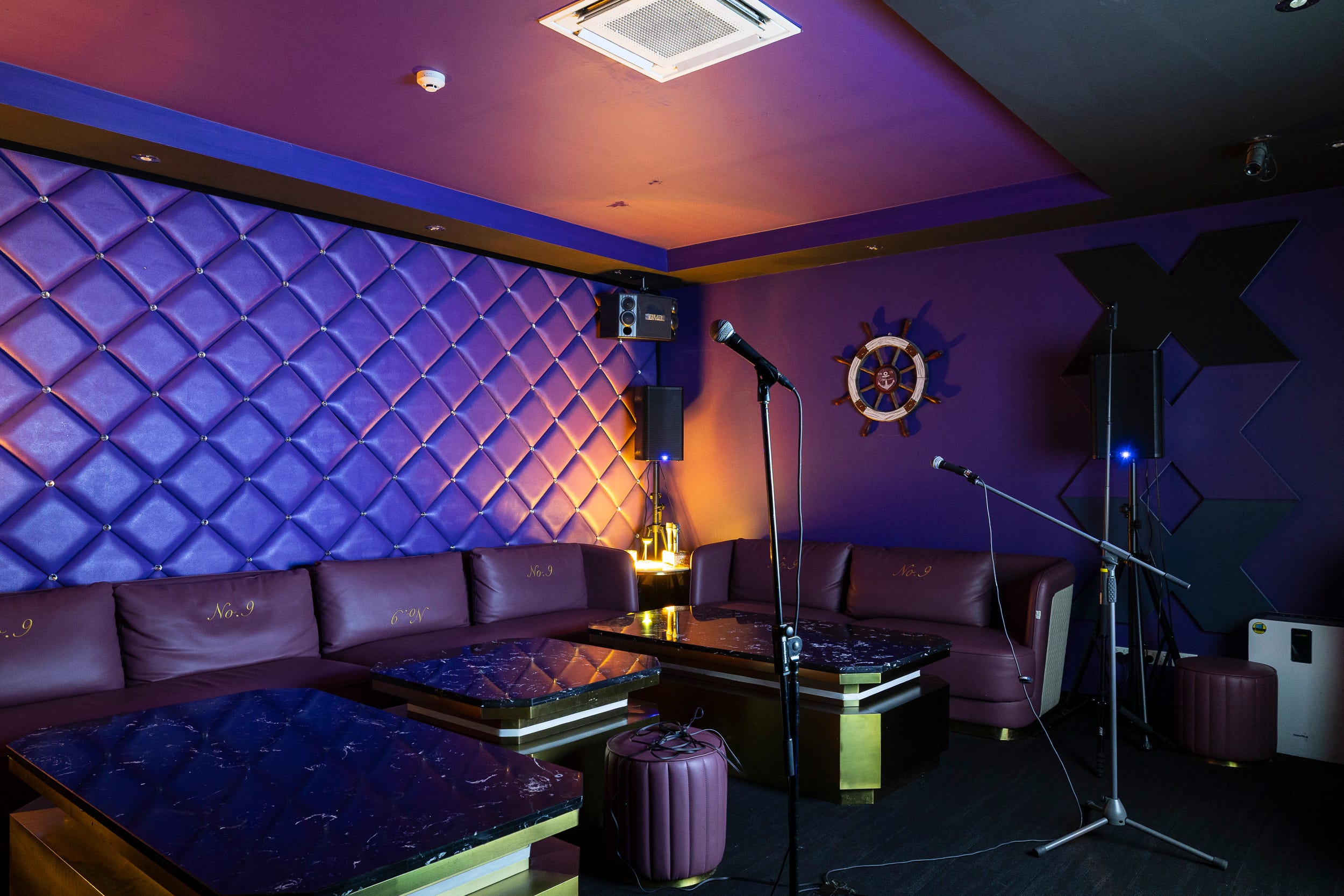
With the new options, a few upgrades were in order. Redeveloping the software from a Max/MSP to a browser-based app, I wanted the audience to be enveloped in the dusk soundscapes, so I imagined both the soundscapes and live vocals surrounding the audience in a quadraphonic (four-speaker) array.
For the visuals, I’d become interested in further exploring TouchDesigner, a powerful generative and algorithmic audiovisual software environment, which I’d first come across in the 2024 TD LabRats tutorials series at ILA. In the past couple years, I’d wanted to use TD in a new project, and this rework of Crepuscule provided the perfect opportunity for a first foray.
For the new version’s visuals, I’d first conceived of converting the incoming livestream soundscapes into an evolving spectrogram that the vocalist could sing along to (à la karaoke lyrics), the sounds becoming something of a graphic score.
Further hunting of TD tutorials led me to find a datamoshing setup that blended static images with videos, which felt a much better fit with the themes of livestream data, janky karaoke tech, and distributed agency.
audiences playing with Crepuscule while tuned into the Seoul - Gusan soundscape
The source images became the first 20 Google images of each livestream location, updating whenever the location changed, while the video was an hour-and-fifteen-minute dusk walk through outer Tokyo played at half-speed. Interesting among the image collections were ‘Otsuchi - Otohama’, which positioned picturesque coastal vistas alongside the devastation of tsunamis, and ‘Kyoto - HydroCyberForest’ where bamboo forest and traditional architecture contrasted with hydropower and chemical plant infrastructure.


the source video, revealed through singing the soundscape
To activate and keep the video playing, one microphone needed to be sung into continuously; to change the images, the other microphone responded to ‘snare drum’-like sounds that triggered the next photo. If the image changed whilst the video was playing, the screen would glitch and fuzz, with the datamoshing video adjusting to the new dimensions.
10x speed of audiences across the night
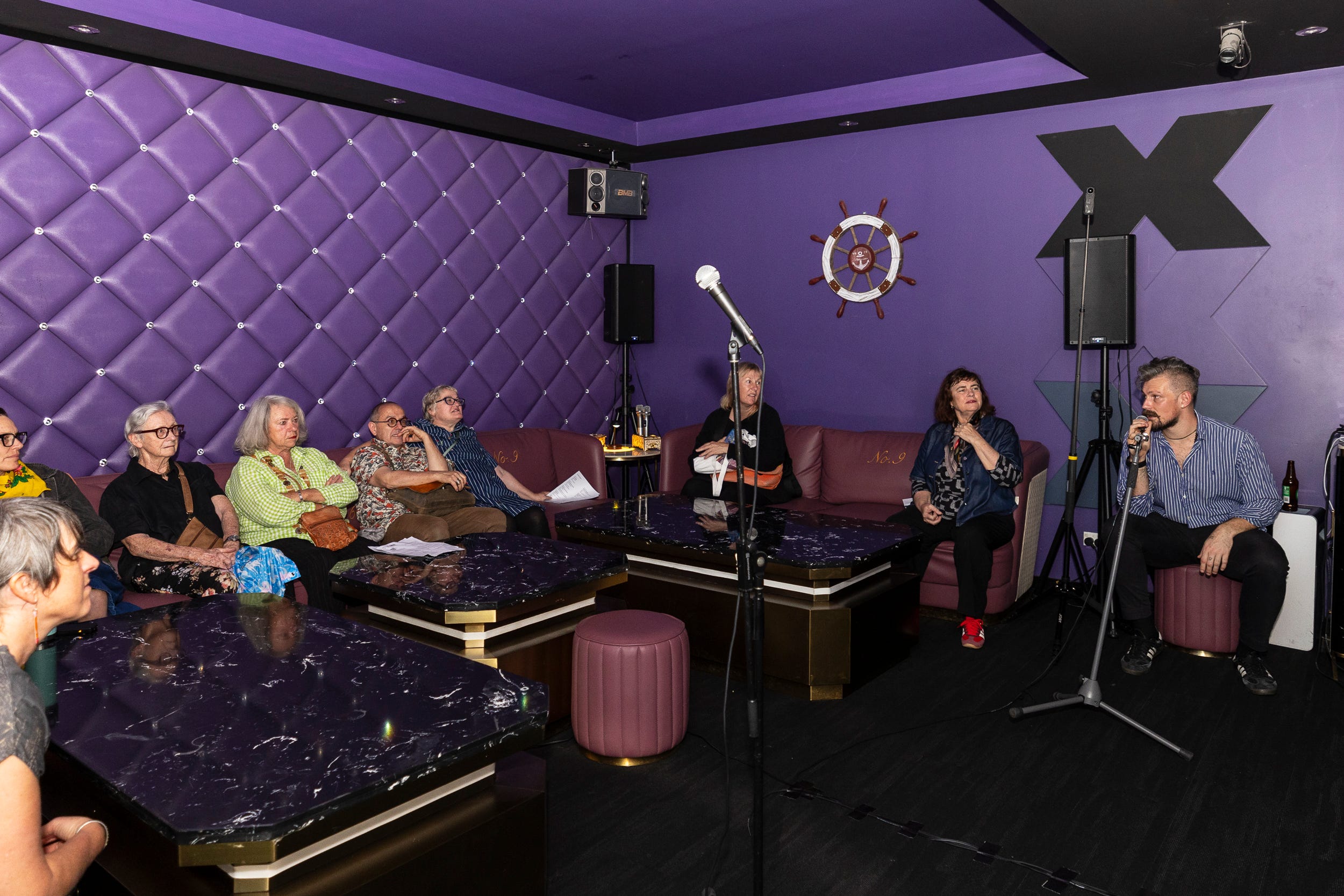
On the night, the work ended up becoming much more playful and social than I’d initially imagined. Some audience members cautiously tested the microphones, while others immediately leaned into the karaoke premise and began performing into the dusk soundscapes.
As the evening went on and people became more comfortable, the room developed its own amorphous energy, somewhere between installation, karaoke session, live performance, and experimental playground. A particularly memorable moment involved a professor friend unexpectedly launching into an improvised rant at the state of the world, which pretty much broke the ice for everyone else in the room.
One of the most rewarding things about this version of Crepuscule was seeing how the karaoke framing completely changed the social dynamic of the work. What was originally a fairly contemplative installation became something much more collective, playful, awkward, unpredictable, and alive. People moved between hesitation, experimentation, singing, laughing, performing, and simply listening. A lot of the interaction happened through discovery rather than instruction, which honestly felt true to the spirit of the piece. The livestreams themselves are unstable and constantly shifting, and once audience voices were folded into the system, no two moments really unfolded the same way.
This new version of Crepuscule also marked my first substantial dive into TouchDesigner and live interactive visuals, combining livestreamed soundscapes, microphone input, reactive image systems, and generative video processes into a single environment. It has opened up a lot of new ideas around participation, ecological systems, live media, and audience agency that I’m keen to continue developing, particularly around my immersive soundscape practice. More than anything, this iteration felt less like revisiting an old work and more like stumbling into the beginning of a new direction.
Check out some of the work by the other amazing artists below!

“A rant on the state of the world”, eh? Save that space for me , Jesse, and do publicise future events well in advance so I can schedule a meaningful visit to Adelaide.